Utica University Receives Largest Endowment Gift to Establish Institute for the Study of Integrative Healthcare

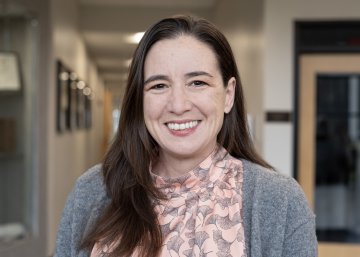
Patrice Hallock, founding director of thenew Institute for the Study of Integrative Healthcare, speaks at a news conference announcing the institute. To the right: Utica College Provost Todd Pfannestiel and President Laura Casamento.
“This represents one of the largest charitable gifts in Utica’s history, and the largest singleendowment gift since our founding.”
President Laura Casamento announced today that Utica University will establish an exciting new initiative, The Institute for the Study of Integrative Healthcare(ISIH), made possible through an anonymous multi-year gift commitment totaling $2.8 million.
“This represents one of the largest charitable gifts in Utica’s history, and the largest singleendowment gift since our founding,”Casamento said.
The multi-disciplinary institute will promote advanced learning and research in the emergingfield of integrative healthcare, which brings together a broad range of practices in support ofpatient health and well-being, Casamento said.
The donors, who have requested to remain anonymous, decided to make this philanthropicinvestment in Utica out of their firm belief that the college has a longstanding record of innovationand responsiveness to the changing landscape of the healthcare delivery system, Casamento said.
The Institute is a natural extension of the University’s mission and vision to pursue interdisciplinarystudy, particularly with respect to programs in the health professions, and improving patient carethrough applied research. The work of the Institute will provide many opportunities for studentsto collaborate and participate in professional research. In addition, the college will seek toestablish strong partnerships with healthcare providers locally, regionally and nationally.
“What will be especially unique about the Institute, is the fact that of the roughly 50 similar institutes currently functioning nationwide, the Utica Institute will be one of only a handful that is anchored in a four-year professional institution witha liberal arts base,”said Utica University Provost Todd Pfannestiel. "The vast majority of these institutes are tied directly to medical schools; however, the Utica Institute will be uniquely positioned to explore integrative healthcare in an integrative educational model, which will include the traditional liberal arts, such as sociology and history among others, as well as business studies such as healthcare administration. Utica University is going to become a trailblazer with this model, made possible by the generosity and trust that the donors have placed in our college.”
The Institute will leverage technology to connect faculty, students, community members,practitioners, social service agencies and government to examine the relationship betweenintegrative healthcare, patient health and professional practice. Students in physical therapy,occupational therapy, nursing, healthcare administration and sociology/anthropology will engagein meaningful experiences relating to their fields of study. Faculty associated with the Institutewill take a transdisciplinary approach to their study to directly prepare students for their intendedcareers.
“Integrative healthcare acknowledges the varied strategies that individuals may choose to keepthemselves healthy,” said Patrice Hallock, professor of education and founding director of thenew institute. “It includes a broad range of strategies – some of which are evidence-based andsome perhaps not – which could include natural, cultural and other traditional therapies thatpeople use to keep themselves healthy. In short, it is treating the ‘whole’ patient.”
“We want to learn more about healthcare strategies that may be common to other cultures andtraditions – like acupuncture – so that we can integrate them into our paradigm of what it meansto be healthy,” Hallock said. It becomes particularly important, she said, in providing healthcarefor immigrant and refugee populations.
Plans also include bi-annual national conferences, bringing together faculty, students,practitioners and evidence-based research principals.
Hallock, who currently serves as director, said that a national search for the Institute’s permanentdirector will begin later this fall.
The news comes just months after ground was broken for the Utica University Science Complex, a25,000-square foot, $12-to-$14 million building to provide state-of-the-art classroom and labfacilities for majors such as biology, chemistry, geoscience and physics while also supportinghealth profession studies.
For more information, contact Hallock at phallock@utica.edu.